Learn everything about the closest town to Machu Picchu
Aguas Calientes is the closest town to the Inca citadel of Machu Picchu. Here you will find the last train station, making it an essential stop for travelers. Located just 10 kilometers from the World Wonder, this small town offers a wide variety of attractions, in addition to top-level tourist services. Learn more about Aguas Calientes, the base town where the journey to Machu Picchu begins.
- What makes Aguas Calientes special?
- What is the train route like to get there?
- What to do in Aguas Calientes?
- How to take the buses from Aguas Calientes to Machu Picchu?
- Interesting facts about Machu Picchu town
- Frequently Asked Questions
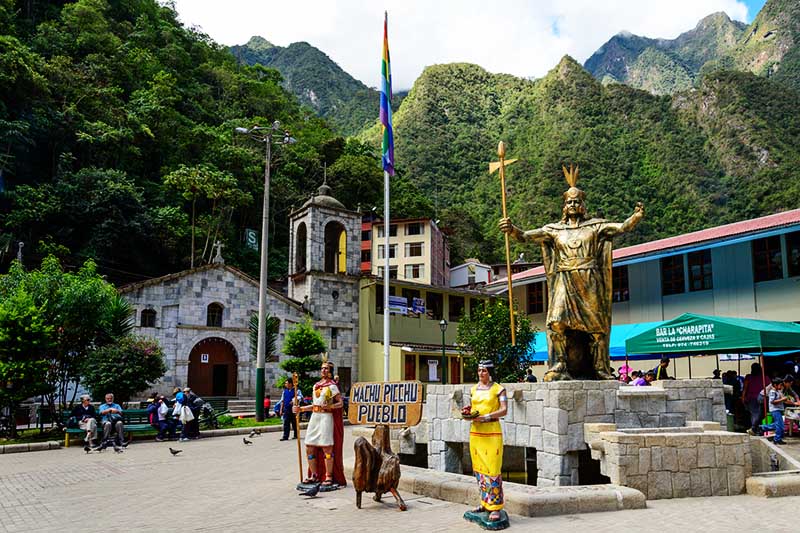
Main square of Aguas Calientes the town before reaching Machu Picchu
What makes Aguas Calientes town special?
- Aguas Calientes town is a remote place surrounded by mountains, cliffs, rivers, and an impressive cloud forest.
- There are only two ways to reach this place. The main route is the train line that goes through the Sacred Valley, while the second option is the Hidroelectrica route, which also follows train tracks from the town of San Teresa.
- No cars circulate in Aguas Calientes, and mobility is only on foot due to its small size. The only transportation you will see are buses that travel the route to the entrance of the Inca city of Machu Picchu.
- This town is primarily dedicated to tourism, so a wide variety of services, such as hotels, restaurants, bars, etc., prevail.
- In Aguas Calientes, there are also various tourist attractions, such as the hot springs, Mandor waterfalls, the artisan market, the site museum, nature walks, and more.
| CHARACTERISTICS OF AGUAS CALIENTES | ||
|---|---|---|
| Category | Characteristics | Details |
| Location | Town located in the province of Urubamba, at the foot of Machu Picchu. | It is located in a transition zone between the Andes and the Amazon, which creates a more humid microclimate and very dense vegetation. |
| Access | Accessible by train from Cusco or Ollantaytambo. You can also reach it via the Hidroelectrica route. | There are no roads connecting it directly to other cities. Everything arrives by train or on foot. |
| Name | Its official name is Machu Picchu Pueblo, but it is commonly known as Aguas Calientes. | The name comes from the natural hot springs that were known before the tourism boom. |
| Altitude | Approximately 2,040 meters above sea level, lower than Cusco. | Many travelers prefer to acclimate here, as the oxygen levels are slightly higher than in Cusco. |
| Natural Surroundings | Surrounded by mountains covered with abundant tropical vegetation and next to the Urubamba River. | The area is home to wild orchids, butterflies, and endemic birds. There is even a small botanical garden dedicated to orchids. |
| Climate | Warm and humid with frequent rain during much of the year (October to March). | The morning mist creates the “city among the clouds” effect that many people experience before hiking up to Machu Picchu. |
| Economy | Almost entirely dedicated to tourism. | The local economy relies almost entirely on tourist traffic. When train services are suspended due to adverse conditions, the town practically comes to a standstill. |
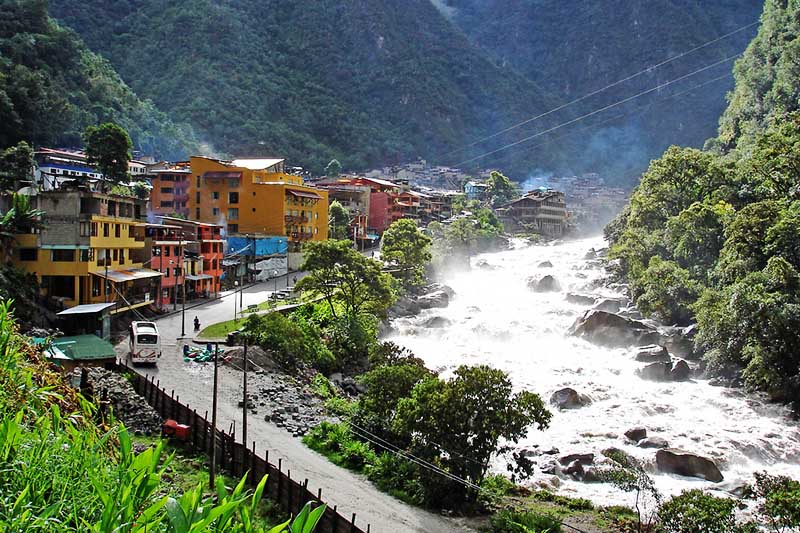
Machu Picchu town also called Aguas Calientes
What is the train route like to get there?
By train from Ollantaytambo:
- To reach Aguas Calientes, you must first travel to the city of Cusco.
- From there, you will take a car or minivan to the train station in the town of Ollantaytambo. The usual travel time is 1 hour 45 minutes.
- Upon arriving at the Ollantaytambo station, you will travel by train to reach Aguas Calientes. The journey takes nearly 2 hours.
By the alternative Hidroelectrica route:
- To reach Aguas Calientes via the Hidroelectrica route, you need to take a bus from Cusco to the town of Santa Teresa. The journey is approximately 5 hours.
- After arriving in Santa Teresa, you must take a shared taxi to the Hidroelectrica station, a short trip of around 30 minutes.
- Upon reaching Hidroelectrica, you can choose to travel to Aguas Calientes by train or take a free hike. The route is 10 kilometers on flat trails and can be completed by walking in two hours.
What to do in Aguas Calientes?
Aguas Calientes offers a wide variety of tourist services at all levels, as well as natural, historical, and cultural attractions that enhance your stay in this town.
Restaurants
- El indio feliz – One of the most famous restaurants in the town. It offers French, Peruvian food, and more. The decoration is very eye-catching and comfortable.
- Incontri del Pueblo Viejo – A restaurant offering Italian, South American, contemporary, and Peruvian cuisine. The place is pleasant. The food is delicious.
- Tinkuy Buffet at Sanctuary Lodge – An exclusive restaurant located next to Machu Picchu. It offers Peruvian and international cuisine. The food is of excellent quality.
- La Boulangerie de París – A bakery, pastry shop, and café that offers French-style breakfasts and brunch. Their desserts are delicious.
- El Mapi Restaurant – This restaurant offers breakfast, lunch, and dinner buffets. It belongs to the Inkaterra hotel chain.
Bars
- Mapacho Craft Beer & Peruvian Cuisine – This restaurant-bar offers Latin food and pizzas. It also serves craft beers. The service is excellent.
- Bar del hotel El Mapi – The bar’s decoration is striking. It has a counter where you can enjoy a variety of cocktails. The music is great.
- Inti House – A well-decorated place with a good view. It offers pizzas, Latin American food, and a variety of cocktails, wines, and beers.
The hot springs
- The hot springs in Aguas Calientes are a great option to relax after visiting Machu Picchu.
- These waters, coming from mountain springs, are believed to have healing properties for rheumatic diseases.
- Surrounded by mountains, the place offers an ideal outdoor relaxation space.
- It is located on Hermanos Ayar street, s/n. (at the highest part of the avenue).
- The opening hours of the Aguas Calientes hot springs are from 5 a.m. to 8:30 p.m.
- The entry fee for foreign adults is 20 Peruvian soles, and for nationals, 10 soles.
Butterfly house
- The Machu Picchu Butterfly House is one of the best places to visit with family.
- It is located on the Hiram Bingham road (a 15-minute walk from the town).
- This museum hosts various species of butterflies, some of which can only be found in Machu Picchu.
- It’s a great option, especially if you’re traveling with children.
- You will see hundreds of butterflies flying freely.
- The butterfly house opened in 2006. It now serves as a research facility and an alternative for visitors who have free time in Machu Picchu.
- The butterfly house is open daily from 9 a.m. to 5 p.m.
- The entry fee for foreign adults is 20 Peruvian soles, and for nationals, 10 soles.
Machu Picchu Site Museum
- The Machu Picchu Site Museum exhibits pieces that were discovered during the early excavations at the World Wonder.
- It also features interactive displays that explain the excavation and conservation process of Machu Picchu.
- The Manuel Chavez Ballon Site Museum is located on the Hiram Bingham road, at the height of the Old Bridge Ruins, kilometer 112 of the railway.
- To reach it, you must walk about 20 minutes, but the route is very scenic.
- The museum’s opening hours are from 9 a.m. to 4 p.m., Monday through Sunday.
- The entry fee for adults is 22 Peruvian soles, and for higher education students, 11 soles.
Hike to Putucusi Mountain
- Aguas Calientes’ geographical diversity allows for exciting adventures around the outskirts.
- There are many nearby attractions, among forests, flowering fields, and views of rivers and valleys.
- Popular attractions you can discover include: Alcamayo waterfalls, Kernel Temple, and Putucusi mountain (closed to the public).
- Most of the trails are flat, making the hikes not very demanding.
- Along the way, you can also find a wide variety of local wildlife.
Currently, access to Putucusi Mountain is closed. The entrance used to be via vertical wooden stairs, but over time, they became damaged, making it nearly impossible to ascend. The route was considered very risky, so it was decided not to maintain it.
Mandor Gardens
- Mandor is a large natural attraction surrounded by abundant vegetation and a stunning waterfall.
- It is located about an hour’s walk from Aguas Calientes town.
- The Mandor waterfall is a natural attraction with a drop of more than 30 meters.
- You can also see a wide variety of birds and butterflies. Despite the tourism, the place is still home to various wildlife.
- The place is not very crowded by tourists, so it is still possible to enjoy it without many people around.
- The entrance fee is 10 Peruvian soles (approximately 3 US dollars).
How to take the buses from Aguas Calientes to Machu Picchu?
- To ascend from Aguas Calientes to Machu Picchu, you must board the buses that travel along the Hiram Bingham road.
- This mode of transport is the only one authorized to reach the Inca citadel.
- The bus station is located on Hermanos Ayar Avenue, just a few meters from the train station and the town’s main square.
- The buses depart every 10 minutes. The ticket office is next to the bus station.
- The bus trip from Aguas Calientes to Machu Picchu takes approximately 30 minutes.
- Alternatively, you can also hike, although it is an uphill route with stone steps. It is recommended to take this route when descending back to Aguas Calientes.
| Bus fares to Machu Picchu | ||
|---|---|---|
| Passenger Type | One way | Round trip |
| Foreign Adult | 12 dollars | 24 dollars |
| Foreign Child | 7 dollars | 12 dollars |
| Peruvian Adult | 8 dollars | 15 dollars |
| Peruvian Student | 6 dollars | 10 dollars |
| Peruvian Child | 5 dollars | 8 dollars |
Spending the night in Aguas Calientes offers a clear advantage: you can be at Machu Picchu early. You might even be the first person to board the buses and be there. The town has a variety of accommodations, including a camping area for those who wish to camp.
Interesting facts about Machu Picchu town
- The origins of Aguas Calientes date back to 1901 when workers building a railway line settled in the area.
- Japanese citizen Oscar Yokichi Nouchi was the first mayor of Aguas Calientes. Before that, Yokichi had been hired for the construction of the railway line.
- With the international spread of Machu Picchu in 1911, the area began to slowly populate.
- Today, it is the town with the highest tourist influx in Peru. It is estimated that more than 1 million tourists visit Machu Picchu each year.
- There is ongoing discussion in Aguas Calientes about building a cable car that would replace the bus journey from Aguas Calientes to Machu Picchu.
Frequently Asked Questions
1) Where is Aguas Calientes?
Aguas Calientes, also called Machu Picchu Pueblo, is located in the province of Urubamba, at the foot of the Inca citadel of Machu Picchu. This small town is surrounded by mountains covered with vegetation and is the starting point for visitors heading to the World Wonder.
2) How can I get to Aguas Calientes?
The most common way to get there is by train from the city of Cusco or from the town of Ollantaytambo. There is also an alternative route via Hidroelectrica, which combines land transport and a short walk to Aguas Calientes.
3) How long does it take to get to Aguas Calientes from Cusco?
The train journey usually takes around 4 hours. First, you travel from Cusco to Ollantaytambo (approximately 1 hour 45 minutes), and then the train ride to Aguas Calientes takes about 2 hours.
4) How close is Aguas Calientes to Machu Picchu?
Aguas Calientes is about 10 kilometers away from Machu Picchu. From the town, you can either take the bus or walk up an ascending path to the citadel.
5) Can I reach Aguas Calientes by car?
No, Aguas Calientes has no roads connecting it directly to other cities. The only way to get there is by train or by walking from the Hidroelectrica station, making the town an isolated destination amidst nature.
6) What can I do in Aguas Calientes?
The town of Aguas Calientes offers various tourist attractions, such as the hot springs, the butterfly house, the Machu Picchu site museum, and several nature walks. There is also a wide range of hotels, restaurants, bars, and local experiences.
7) Is it worth spending a night in Aguas Calientes?
Yes, spending the night in Aguas Calientes allows you to visit Machu Picchu early in the morning and explore the town and its surroundings more leisurely. You can also enjoy its restaurants, hot springs, and natural landscapes.
8) How can I get from Aguas Calientes to Machu Picchu?
The most common way is to take the buses that leave from the center of the town. The journey takes approximately 30 minutes. You can also walk up a steep path with constant stairways.
9) How is the climate in Aguas Calientes?
The climate is warm and humid throughout most of the year. The rainy season typically runs from October to March, while between April and September, the weather is generally more stable.
10) Is it safe to walk around Aguas Calientes?
Yes, Aguas Calientes is a small town oriented toward tourism. Its main streets are well-signposted and connect the major attractions, restaurants, and hotels, making it easy to walk around comfortably.
Advice from people who have been there
 By: Sandra R
“Beautiful town“
“We were told we had to reach Aguas Calientes to get to Machu Picchu, and we stayed with that idea, “we had” to get to Machu Picchu through this town. Somewhat disappointed by the comment, we headed to Aguas Calientes, but when we arrived, it was much more than we expected. There are no vehicles because there are no roads, it’s a place with no urban planning, just houses and passages behind other houses and passages. But it is one of the best places we saw on the way to Machu Picchu, everything around it is green. Oh, wait, the river is not green, but everything else is. It’s a very beautiful little town, don’t overlook it, and go to the hot springs, they are wonderful 38“
By Ticket Machu Picchu – Last updated, March 13, 2026