Biodiversity of Machu Picchu: birds, orchids, and what to see
The Inca city of Machu Picchu is globally recognized not only for its historical and architectural value, but also for the natural environment that surrounds it, where mountains and abundant vegetation create one of the most unique landscapes in the world. Located between the Andes and the Amazon rainforest, this place is home to extraordinary biodiversity: more than 400 species of birds and one of the largest concentrations of wild orchids on the planet, making Machu Picchu an exceptional destination where history and nature coexist in a unique way.
- Machu Picchu, a place full of biodiversity
- More than 400 bird species in Machu Picchu
- Diversity of orchids in Machu Picchu
- Best time to observe the flora of Machu Picchu
- Tips to enjoy the biodiversity of Machu Picchu
- Frequently asked questions
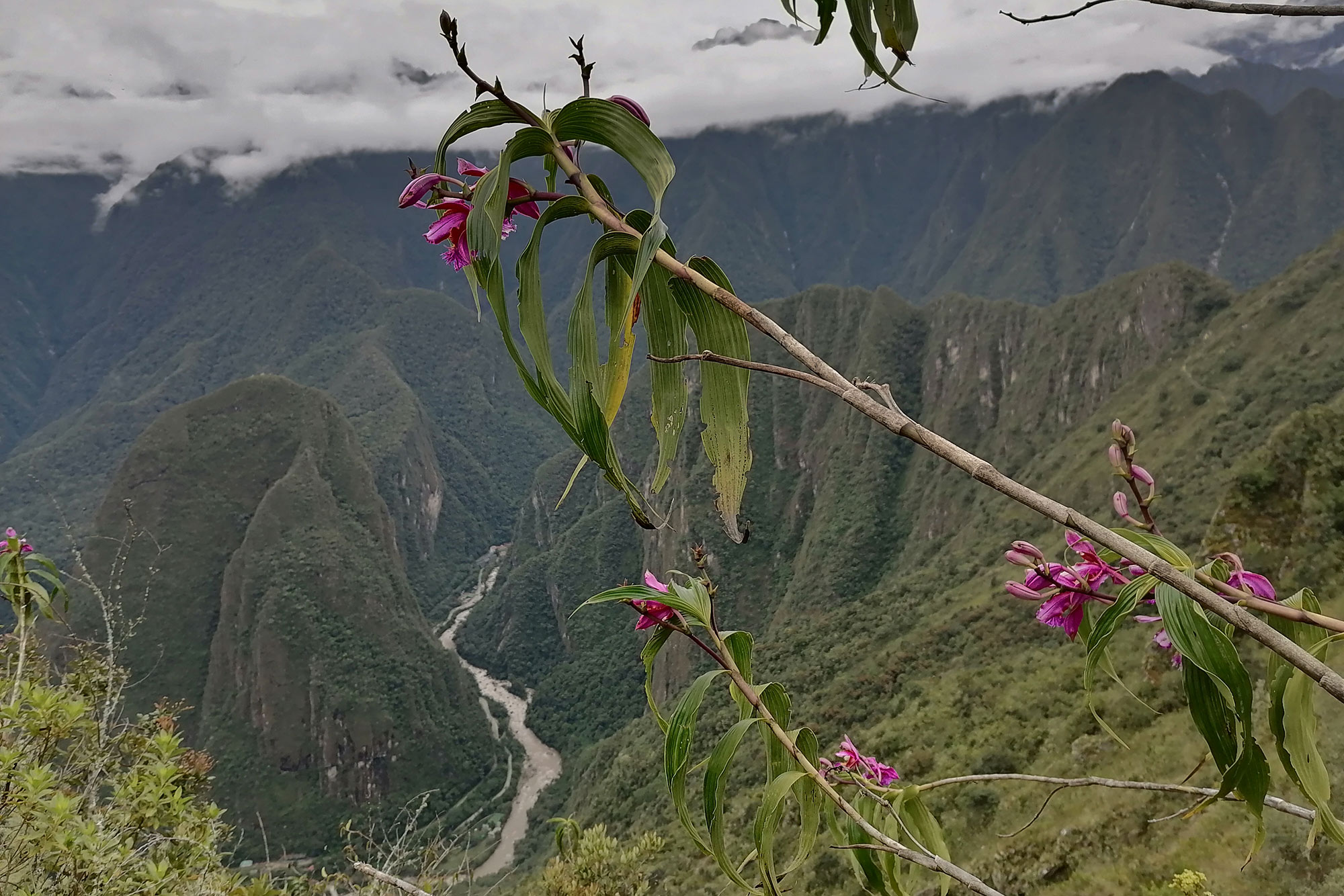
Natural landscapes of Machu Picchu
In Machu Picchu, many orchids go completely unnoticed by most visitors, despite being just a few meters from the main paths. This is because several species are very small and grow on trunks or among the vegetation, blending perfectly into the environment. However, during the rainy season, the setting becomes more vibrant, where orchids appear almost spontaneously, revealing surprising colors and shapes.
Machu Picchu, a place full of biodiversity
- The Historic Sanctuary of Machu Picchu is a globally known destination for its historical and architectural value, built in the middle of mountains by the Inca culture, serving as a royal residence for the elite as well as a religious sanctuary.
- From a broader perspective, the appeal of Machu Picchu also lies in its privileged geographical location and its wide variety of microclimates, as it is in full transition between Andean and tropical ecosystems.
- This condition turns every landscape and every route into a unique experience, where natural richness complements and enhances the archaeological setting.
- Among the great diversity of flora and fauna in Machu Picchu, the following stand out: 53 species of mammals, 700 species of butterflies, 2,350 species of plants, 125 species of arthropods, 13 species of fish, 22 species of reptiles, 12 species of amphibians, and 423 species of birds.
- In addition to the remarkable diversity of orchids, the spectacled bear and the Andean cock-of-the-rock are animals considered symbols of this area, whose presence reinforces the ecological value of the Historic Sanctuary.
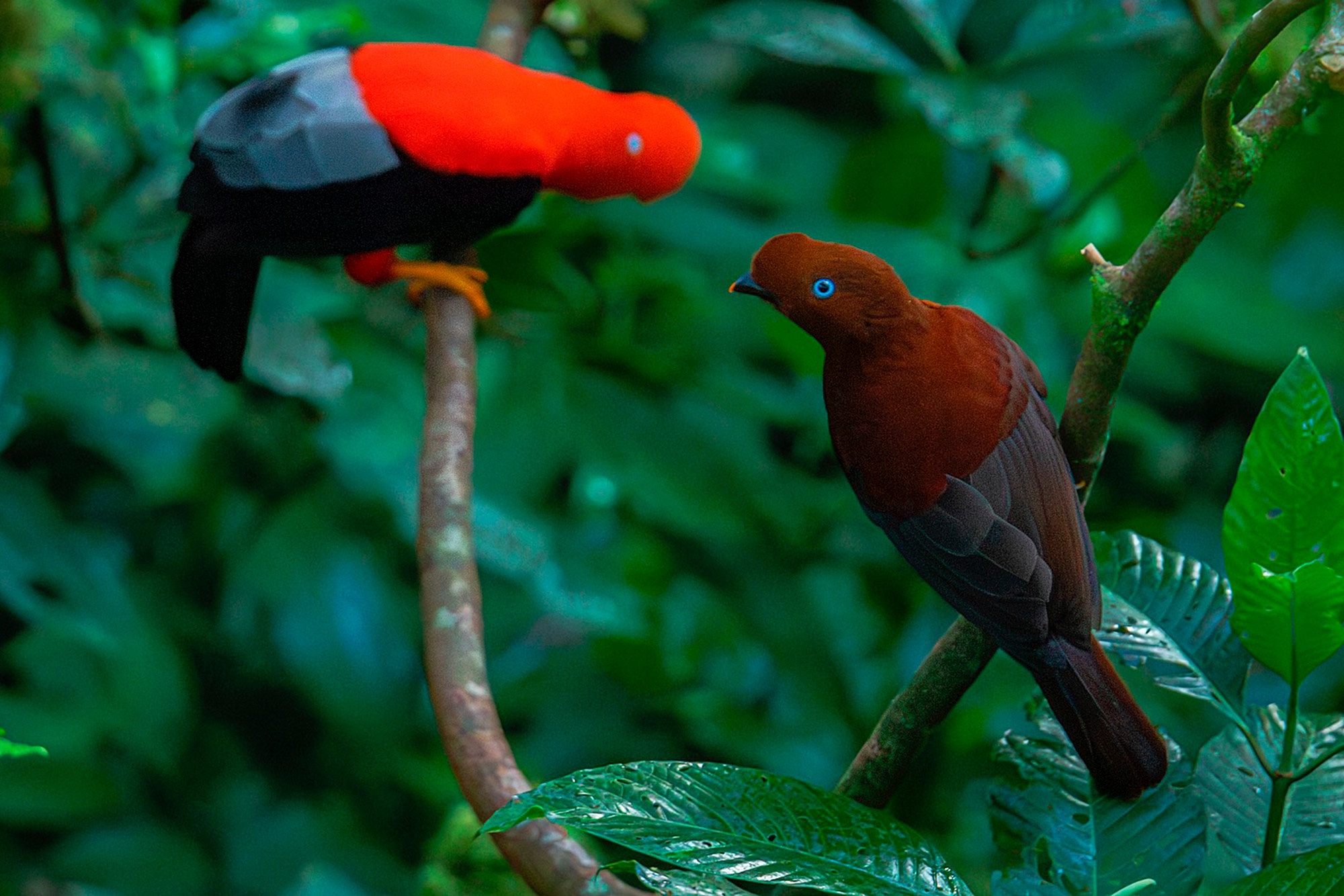
Andean cock-of-the-rock
More than 400 bird species in Machu Picchu
- Machu Picchu was built respecting every inch of the mountain, coexisting perfectly with the surrounding nature; and even today, it was not only considered a sacred and residential construction, but also a sanctuary of natural beauty and energy.
- Many visitors who arrive at the Inca city seek to discover the enormous number of birds found in the natural environment surrounding the Historic Sanctuary.
- On a birdwatching trip to Machu Picchu, remember that Peru is the third country with the highest number of bird species in the world. In Machu Picchu alone there are more than 400, while across the rest of the country, nearly 2,000 species are recorded across various ecosystems.
- For example, it is common to observe endemic species such as the white-bellied hummingbird or the Gould’s Inca, and it is also possible to see the Andean cock-of-the-rock, an endangered species considered the national bird of Peru.
- These are some of the most representative birds that can be observed during a visit to the Historic Sanctuary:
| Most representative birds of Machu Picchu | ||||
|---|---|---|---|---|
| Bird | Scientific name | Main characteristics | Habitat in Machu Picchu | Sighting level |
| Andean cock-of-the-rock | Rupicola peruvianus | Intense red plumage and disk-shaped crest | Humid forests and ravines | Medium |
| Crested quetzal | Pharomachrus antisianus | Metallic green colors and red chest | Cloud forest | Low |
| Emerald toucanet | Aulacorhynchus prasinus | Colorful beak, green body | Low and humid areas | Low |
| Gray-breasted mountain toucan | Andigena hypoglauca | Large size, multicolored beak | Mountain forests | Medium |
| Andean motmot | Momotus aequatorialis | Long tail shaped like a pendulum | Mountain forests | Medium |
| Versicolored barbet | Eubucco versicolor | Very striking colors (red, blue, green) | Low humid forests | Low |
| Crimson-mantled woodpecker | Piculus rivolii | Intense red plumage on the upper part | Mountain forests | Medium |
| Tanager | Thraupidae family | Bright colors and active behavior | Tree canopies | High |
| Hummingbird | Trochilidae family | Small, fast, and iridescent colors | Near flowers | High |
| Andean guan | Penelope montagnii | Large bird, more terrestrial | Quiet trails | Medium |
Diversity of orchids in Machu Picchu
- The territory of Machu Picchu has lush flora, where ornamental flowers stand out, but especially the great diversity of orchids. Of the more than 400 orchid species scientifically recorded, around 38 are endemic to the Historic Sanctuary.
- In Machu Picchu, pollination is fascinating, as it serves as a refuge for exotic birds and more than 300 species of butterflies, turning pollination into an incredible multicolored spectacle.
- Orchids are the flowers with the highest number of species recorded worldwide, with more than 30,000 specimens, thanks to their existence for 60 million years and their adaptation to many habitats across the planet.
- The largest number of orchids can be found in Malaysia and South America; only the poles and the most arid deserts lack them.
- The hiking routes of the Historic Sanctuary are the best option to explore the diversity of orchids. Among the main options are: the Huayna Picchu mountain route (3A), the Temple of the Moon route (3C), and the Machu Picchu mountain route (1A).
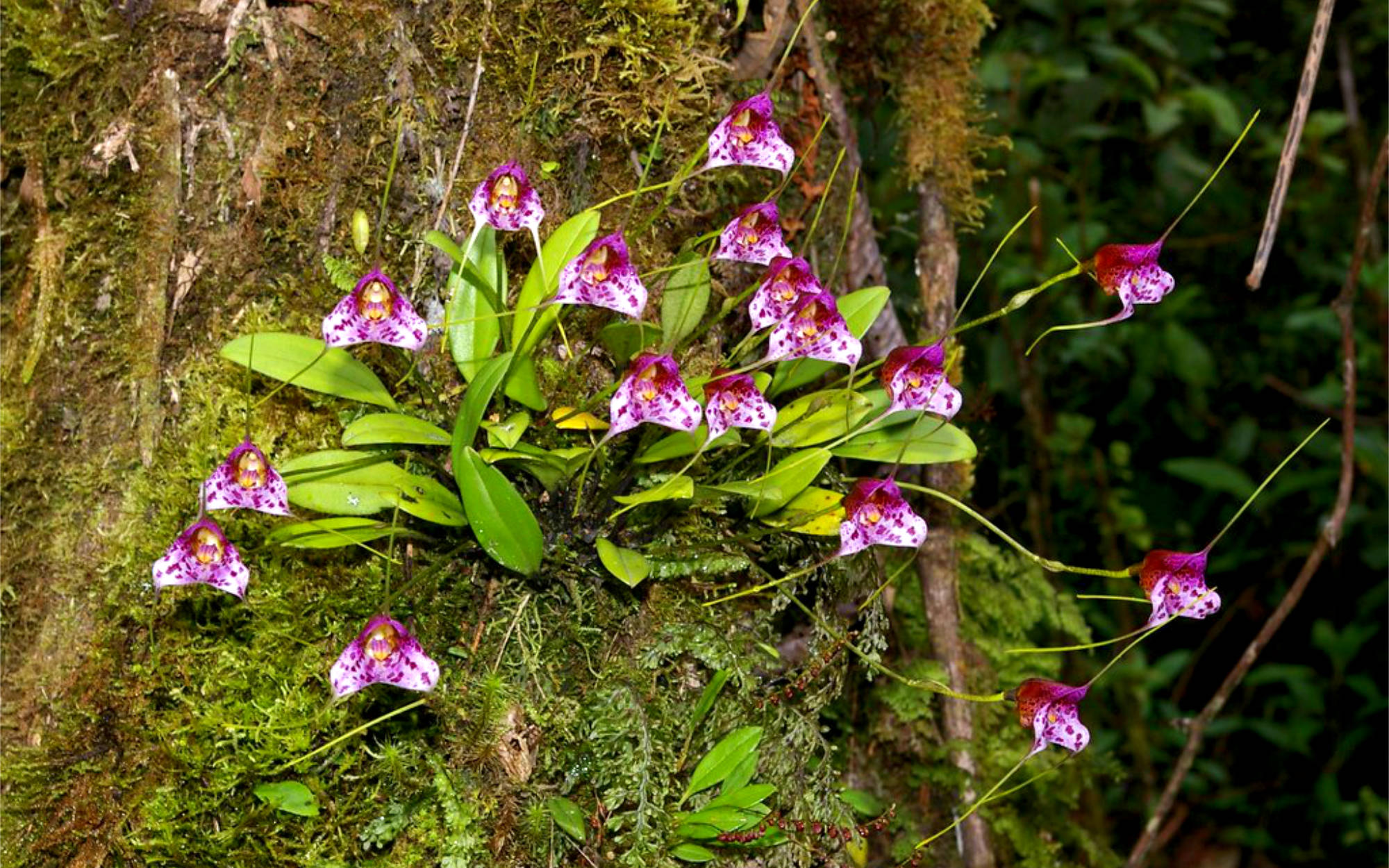
Orchids of Machu Picchu
Best time to observe the flora of Machu Picchu
- The territory of Machu Picchu has two well-defined climatic seasons throughout the year: the dry season (April to October) and the rainy season (November to March).
- Although flora can be observed year-round, during the rainy season vegetation is more lush and landscapes are much greener.
- Therefore, the best time to observe the flora of this territory is probably between January and March, when rainfall is more frequent and nature is at its most flourishing stage.
Tips to enjoy the biodiversity of Machu Picchu
- Reservations to visit the Inca citadel of Machu Picchu must be made at least one month in advance, although if you are looking for one of the most popular tickets, such as the classic circuit or Huayna Picchu, they should be booked up to three months ahead.
- The route to Huayna Picchu mountain (3A) is also popular for the possibility of finding many orchid species along its trails. Another option is to book the ticket for the Temple of the Moon or Great Cavern route (3C), which is surrounded by flora throughout the entire journey.
- To reach Machu Picchu from the town of Aguas Calientes, the most common option is to take an eco-friendly bus, although there is also a hiking route that crosses paths full of vegetation. This alternative is highly recommended when descending, as it offers a light walk while discovering more of the area’s characteristic flora.
- Hiking routes from Aguas Calientes (Machu Picchu town) are another option to explore nature. The most recommended destinations are: the Mandor gardens, the Alcamayo waterfalls, and the Aguas Calientes waterfalls.
- Book your trip to the Inca citadel with Ticketmachupicchu, and consult with our sales advisors about all available options to make your trip to Machu Picchu an unforgettable experience.
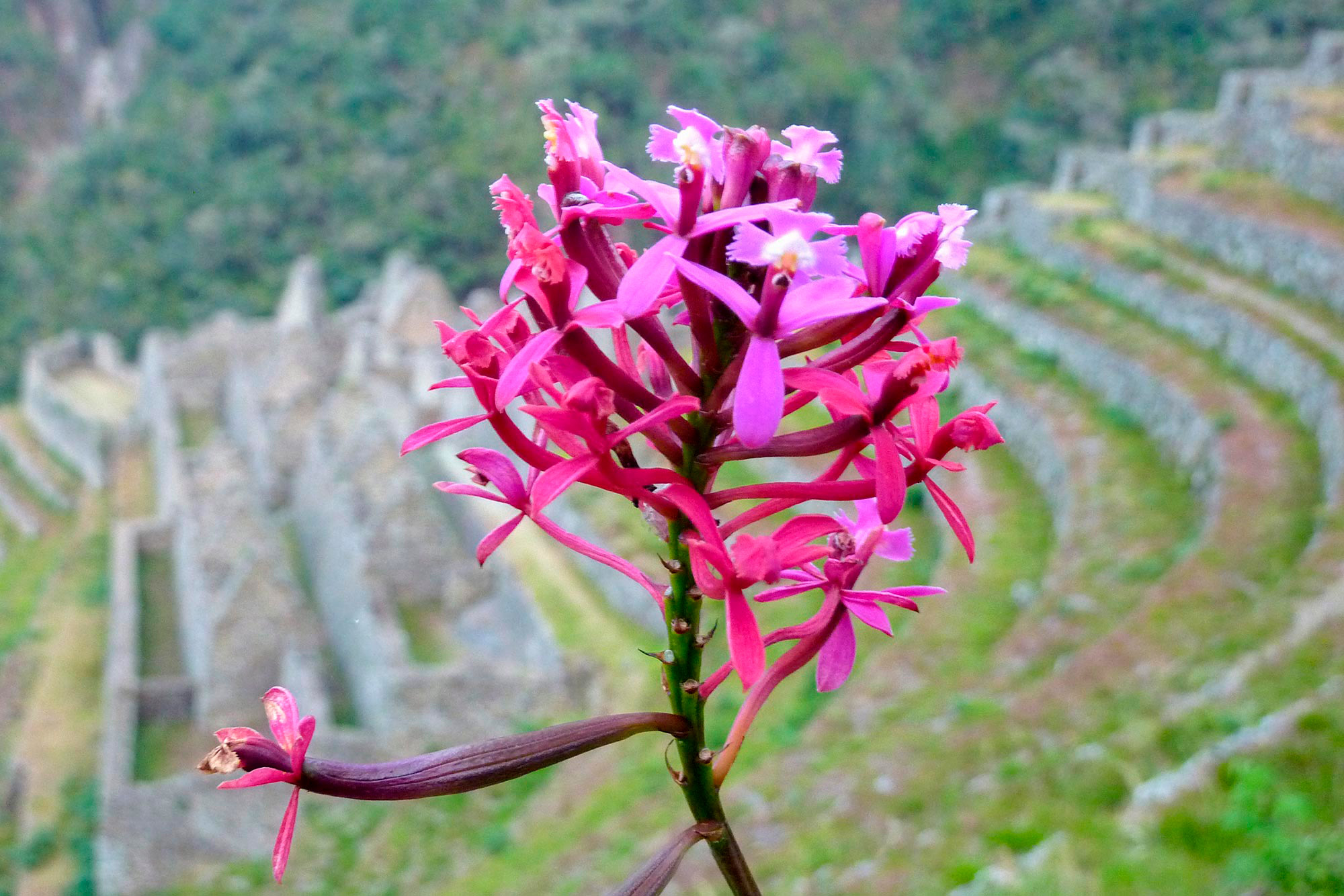
Orchids next to the Inca citadel
Frequently asked questions
1) How many bird species are there in Machu Picchu?
In the Historic Sanctuary of Machu Picchu, more than 400 bird species have been recorded, making it one of the most diverse destinations for birdwatching in South America.
2) What birds can be seen in Machu Picchu?
Among the most representative birds are the Andean cock-of-the-rock, various species of hummingbirds, tanagers, Andean toucans, and birds typical of the cloud forest.
3) How many orchid species exist in Machu Picchu?
In this wonder of the world, around 500 species of wild orchids have been recorded, many of them adapted to the microclimates of the Andean and tropical territory of the sanctuary.
4) Why is there so much biodiversity in Machu Picchu?
The biodiversity of Machu Picchu is due to its location between the Andes and the Peruvian Amazon, which creates a combination of ecosystems and microclimates that favor a great diversity of flora and fauna.
5) What is the best time to see orchids in Machu Picchu?
The rainy season, between November and March, is the ideal time, as vegetation is much more abundant and orchids bloom more frequently.
6) Is it easy to see birds in Machu Picchu?
Yes, especially in the early morning and along hiking routes, where bird activity is higher. Therefore, it is recommended to purchase tickets to Huayna Picchu mountain, the Temple of the Moon, or Machu Picchu mountain.
7) Is Machu Picchu a good destination for birdwatching?
Yes, Machu Picchu is considered one of the best places in Peru for birdwatching thanks to its high diversity and wide variety of habitats.
8) What animals stand out in Machu Picchu?
Among the most notable species in Machu Picchu are the spectacled bear, one of the most remarkable mammals of the Andes, and the Andean cock-of-the-rock, a representative bird of Peru.
9) What type of vegetation predominates in Machu Picchu?
Cloud forest vegetation predominates in Machu Picchu, characterized by high humidity, abundant flora, and a great diversity of species, many of them endemic.
10) What should you bring to observe biodiversity in Machu Picchu?
It is recommended to bring binoculars, a camera, comfortable clothing, waterproof gear, and most importantly, to walk attentively so as not to overlook small species.
Advice from people who have been there
 By: Lindsay D
“The hummingbird we saw in Mapi“
“While we were walking through Mapi (as locals call Machu Picchu), we saw a hummingbird. It moved its wings so fast they were impossible to distinguish, as if only its body was floating. Its beak was almost the size of its body, but the most astonishing thing about this small bird was that its curved beak perfectly matched the flowers where it fed. We saw it from very close, just over three meters away.“
By Ticket Machu Picchu – Last updated, April 24, 2026