Sacsayhuaman: interesting facts and information
The Sacsayhuaman fortress (place where the falcon is satisfied) is an Inca archaeological site located in Peru, just 2 kilometers from the city of Cusco and 3,700 meters above sea level (m.s.l.). According to the Peruvian chronicler Garcilaso de la Vega, the site is “the greatest architectural work that the Incas built during their peak.” Its construction was started by Inca Pachacútec in the 15th century and completed by Huayna Cápac in the 16th century. In 1536, Manco Inca, leader of the Inca resistance from Vilcabamba, fought the Spaniards at this site. Due to the destruction caused by the conquerors, today only 20 percent of what was the architectural complex is visible.
- Location, climate, and other basic features of Sacsayhuaman
- Historical information
- Interesting facts about Sacsayhuaman
- Frequently asked questions
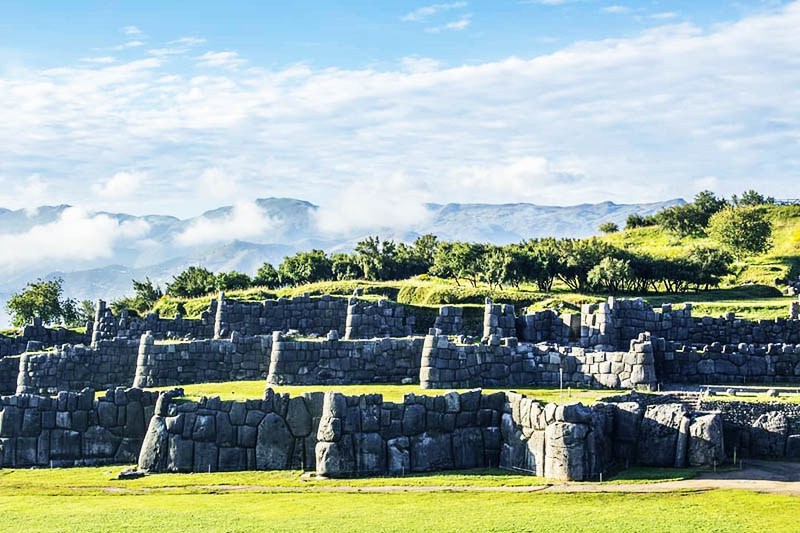
View of the Sacsayhuaman fortress
The Sacsayhuaman Archaeological Park
The Sacsayhuaman archaeological site is only part of the archaeological park of the same name. This area covers 2,997.265 hectares, which houses 96 archaeological sites, among which stand out: Qenqo, Puca Pucara, Tambomachay, Inkilltambo, Chacan, Kusilluchayoc, Kallachaca, Patallaqta, and Amaro-Markawasi. Many of these places are free to enter, you just need to explore the surrounding areas.
Location, climate, and other basic features of Sacsayhuaman:
Where is Sacsayhuaman?
The Sacsayhuaman archaeological site is 2 kilometers from the historic center of the city of Cusco. Located on a hill, it offers a panoramic view of the entire valley. Furthermore, due to its high location, you can see the entire city. The place is surrounded by vast green fields and forests, reflecting the diversity of Andean flora. Sacsayhuaman seems to merge with the surrounding nature.
Climate and altitude
Sacsayhuaman, like Cusco, has a dry and temperate climate. The average annual temperature is 12°C, although it varies depending on the season. From November to March, during the rainy season, rainfall is more constant, providing greener landscapes and fewer visitors. From April to October, in the dry season, rain is unlikely and the skies are clear, which is ideal for outdoor activities. Due to its altitude, at 3,700 meters above sea level, it is nearly 300 meters higher than the ‘Imperial City’, making nights cold and days hot.
How to get there?
There are several ways to reach Sacsayhuaman. The easiest way is to take a taxi, which takes about 15 minutes. Another option is to take public transportation, which will leave you a short distance from the entrance to the archaeological site. You can also hike, which is a somewhat exhausting route with constant stairs, but it only takes an hour from the Plaza de Armas. However, one of the most common ways to get there is by booking a City Tour service, which includes transportation and a guide to Sacsayhuaman and other tourist sites.
Admission price and ticket
Access to Sacsayhuaman is included in the Cusco Tourist Ticket. You can choose between the full option, which includes 16 tourist attractions, or the partial option (circuit 1), which includes four archaeological sites in the city (Sacsayhuaman, Qenqo, Puca Pucara, and Tambomachay). The price of the full Tourist Ticket is 130 soles, while the partial ticket costs 70 soles. The ticket can be purchased online or at the Sacsayhuaman ticket office and other archaeological sites.
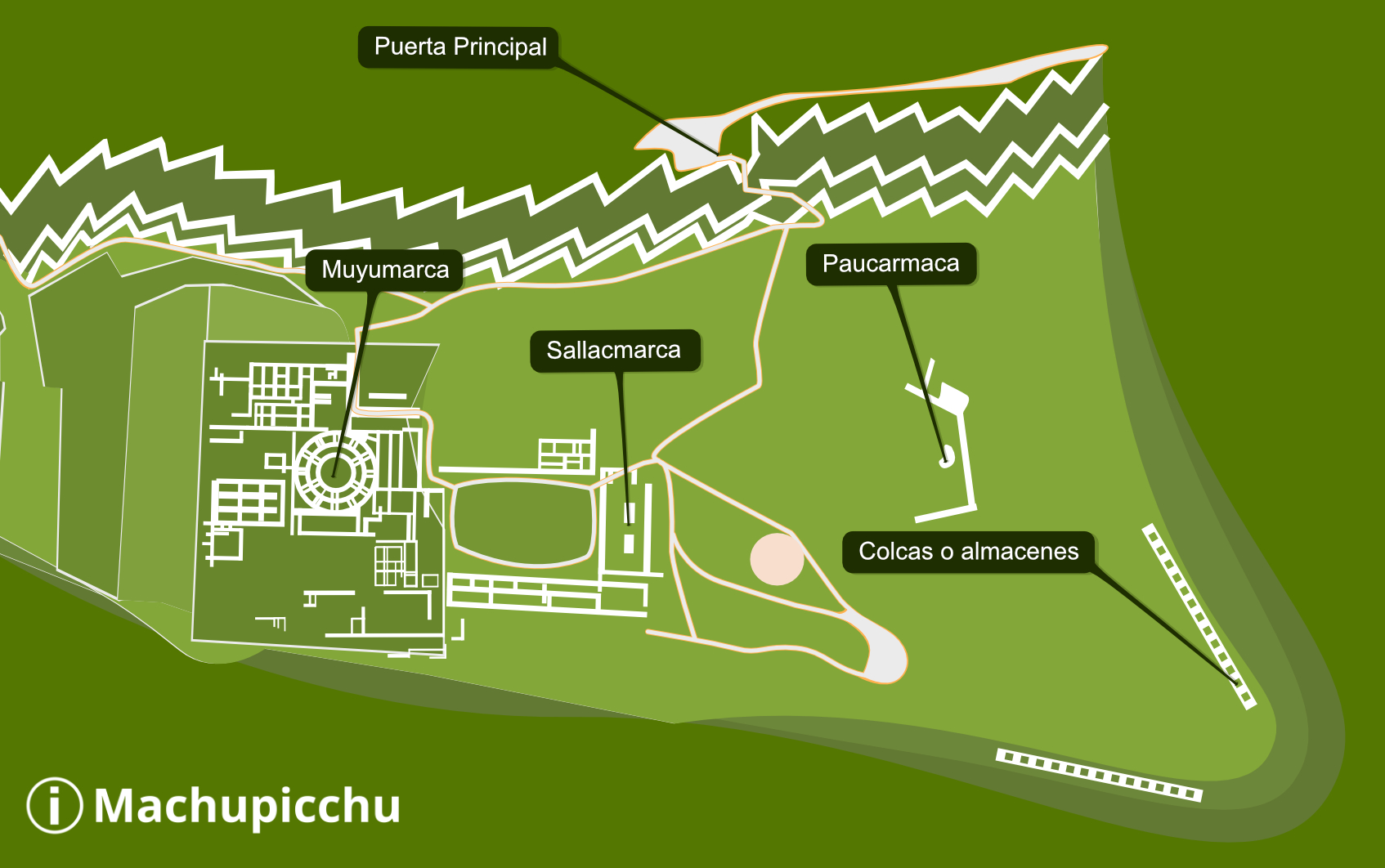
Map of the route to Sacsayhuaman
| MAIN CONSTRUCTIONS OF THE SACSAYHUAMAN ARCHAEOLOGICAL FORTRESS | ||
|---|---|---|
| Sector / Construction | Main Features | Possible Function |
| Zigzag Walls | Three large defensive terraces built with megalithic blocks. Some stones weigh more than 100 tons. | Symbolic and military defense, also interpreted as a representation of lightning or the teeth of a puma (Cusco was shaped like a puma). |
| Watchtowers (Muyucmarca, Sallacmarca, and Paucarmarca) | Ancient towers that dominated the upper part of the complex. Today only circular and rectangular bases remain. | Strategic control, surveillance, and ceremonial functions. |
| Muyucmarca | Main circular tower, located at the highest point of Sacsayhuaman. | Command center, ceremonial site, and possibly an astronomical observatory. |
| Slide | Natural rock formation with large slopes. | Ritual or recreational space, now known for natural slides on the rocks. |
| Inca Throne | Carved stone seat with steps. | Ceremonial space where the Inca witnessed rituals or ceremonies. |
| Suchuna | Rocky area with terraces and stone carvings. | Likely ritual activities and astronomical observation. |
| Chincana Grande | Complex of unexplored underground caves. | Ritual or storage use, many legends exist about tunnels connecting with key points in Cusco. |
| Chincana Chica | Small underground passage near the Slide. | Ceremonial or passage space. |
| Main Plaza | Large open area in front of the walls. | Site for ceremonies, today the Inti Raymi is held there. |
Historical Information:
Who built Sacsayhuaman?
According to various studies, it is estimated that buildings existed at Sacsayhuaman long before the Incas. However, the peak and the immense constructions that are still visible today were started by Inca Pachacútec (15th century) and completed by Huayna Cápac (16th century).
Why was it built?
Due to its location, at the top of the highest hill in the city of Cusco, and its massive construction, it is believed that it was meant to be a fortress. In 1536, Sacsayhuaman was the site of the Inca rebel resistance from Vilcabamba. However, according to several chroniclers, the site was mainly built as a worship site or temple in honor of the Sun. A quote from chronicler Garcilaso de la Vega: “…because they said it was a messenger of war, not of peace, that the fortress was the House of the Sun.”
How was it built?
It is estimated that the construction took more than 70 years and required up to 20,000 men. Stone quarries located 20 kilometers from Sacsayhuaman were used for its construction. It is estimated that the stones that form the main wall weigh up to 100 tons. How they managed to fit such large stones so perfectly remains a mystery.
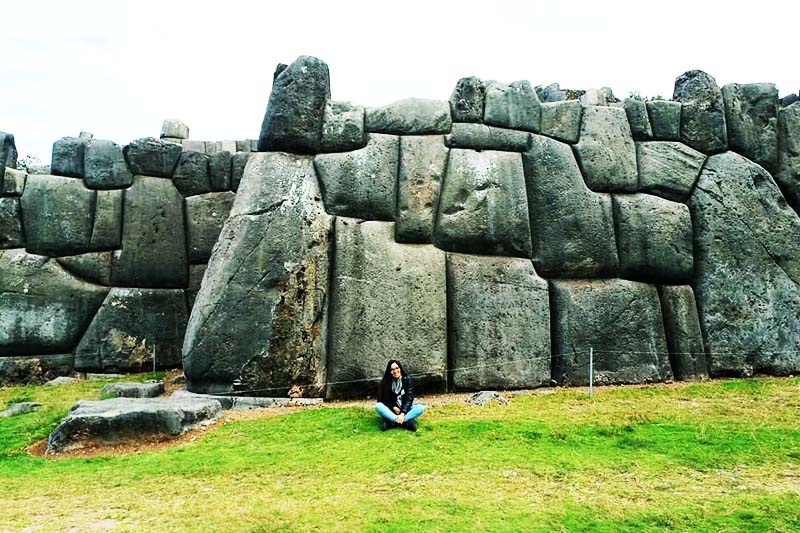
Gigantic stone walls found at Sacsayhuaman
Interesting facts about Sacsayhuaman
The Puma’s Head
According to the Andean worldview, important urban or religious centers were harmoniously integrated with their natural surroundings. Machu Picchu, for example, is shaped like a bird. Various studies suggest that the city of Cusco used to have the shape of a puma. The Sacsayhuaman fortress would form the head of the feline, while the Temple of the Sun or Coricancha represented its genitals.
Demons and Extraterrestrials?
Within the archaeological complex, there is a stone formation made of large stones assembled like a puzzle. The perfection of this and other constructions astonished the Spaniards during the conquest. According to chronicles, they attributed its creation to demons. Today, according to oral tradition, these buildings were the work of extraterrestrials.
Temple or Fortress?
According to various chroniclers, Sacsayhuaman was built as a religious temple. In its main ceremonial area, religious festivities were held in honor of the Sun, the most important deity of the Incas. In 1536, the site was the stage for an attack by the rebel Incas from Vilcabamba, who sought to reclaim the city of Cusco. Fearing another possible attack, the Spaniards destroyed much of the main structures. Today, the Inti Raymi (Festival of the Sun) is celebrated at the archaeological site, a performance in homage to Inca ancestors.
The Resistance and Martyr Cahuide
One of the most astonishing constructions of the archaeological complex is the watchtowers. One of these, known as Muyucmarca, was the scene of one of the most symbolic historical events during the Inca resistance. There, the Inca warrior Titu Cusi Huallpa (known as Cahuide), realizing he was defeated by the European conquerors, jumped from the tower to avoid falling into the hands of the victors. Today, this site is called ‘Cahuide’s Tower’.
Underground Path to Coricancha?
There is an unproven story in Sacsayhuaman about an underground tunnel or ‘chincana’, which supposedly connects the massive fortress with the Temple of the Sun or Coricancha. In reality, there is no concrete evidence to support the rumors. The site has two of these underground caves. The first is narrow, small, and open to visitors. The second, the ‘chincana’ supposedly connecting with Coricancha, is longer but closed to the public. According to various stories, people who ventured inside never returned.
Inca Slides?
Among the numerous tourist attractions inside Sacsayhuaman, there are watchtowers, buildings, bastions, gates, and even Inca thrones. However, without a doubt, one of the most popular spaces are the natural rock slides, known as Inca slides. This natural rock formation is now used by travelers to slide down like a swing. Its original function for the Incas is uncertain.
Qenqo, Tambomachay, and Puca Pucara
Near the site are the archaeological ruins of Qenqo, Tambomachay, and Puca Pucara. All these sites are known as the Sacsayhuaman Archaeological Park. Admission to these four tourist attractions is included in the Cusco Tourist Ticket. The tour of this complex also visits these sites, along with Coricancha, the Plaza de Armas, and the White Christ, from where the full beauty of the ‘Imperial City’ can be appreciated.
This is the Sacsayhuaman fortress!
The Sacsayhuaman archaeological site was one of the urban and religious centers of the Inca empire. This architectural monument is made with stones weighing over 120 tons. How did the Incas fit these stones together without modern technology?
Frequently Asked Questions
1) What is Sacsayhuaman?
Sacsayhuaman is one of the most impressive archaeological sites of the Inca legacy. Located above the city of Cusco, it stands out for its massive stone walls and its historical importance. Visiting this site allows you to better understand the legacy of the Inca Empire and enjoy a privileged view of the entire city.
2) Where is Sacsayhuaman?
The Sacsayhuaman archaeological site is located approximately 2 kilometers from the historic center of Cusco, on a hill that dominates the valley of the city. Thanks to its elevated location, from this place, you can enjoy a panoramic view of the city and its surrounding natural environment.
3) What is the altitude of Sacsayhuaman?
Sacsayhuaman is located approximately 3,700 meters above sea level. This makes it about 300 meters higher than the city of Cusco.
4) How can I get to Sacsayhuaman from the center of Cusco?
There are several ways to get there. Many travelers opt for a taxi, as the trip takes about 15 minutes. It is also possible to use public transport or walk from the Plaza de Armas, although this last option involves a constant climb and can take more than an hour.
5) What is the best way to visit Sacsayhuaman?
One of the most recommended ways is through the Cusco City Tour. This service includes full transportation, a tour guide, and admission to destinations such as: Sacsayhuaman, Qenqo, Puca Pucara, Tambomachay, the Cathedral, and the Qoricancha temple.
6) How much is the entrance to Sacsayhuaman?
Admission is included in the Cusco Tourist Ticket. This ticket costs 130 soles for the full version (16 tourist destinations) and 70 soles for the partial version (4 archaeological sites).
7) Why are the walls of Sacsayhuaman so famous?
The walls of Sacsayhuaman are famous for the size of their stone blocks, some of which weigh over 100 tons. What is most surprising is that the stones fit perfectly together, demonstrating the high level of engineering achieved by the Incas.
8) What is the Rodadero of Sacsayhuaman?
The Rodadero is a natural rock formation with large slopes. Today, it is a very popular space among visitors, who often slide down its smooth surfaces. Although its original function is undefined, it is believed to have had a ritualistic significance.
9) Are there secret tunnels in Sacsayhuaman?
Within the Sacsayhuaman archaeological site, there are underground passages known as chincanas. Some of these caves can be explored by visitors, while others remain closed. Over time, many legends have emerged about tunnels connecting to other places in Cusco, although no definitive evidence exists.
10) How long does the tour of Sacsayhuaman take?
The tour usually takes between one and two hours to explore the site at a comfortable pace. This time allows you to visit the main sectors of Sacsayhuaman and enjoy panoramic views of Cusco.
Advice from people who have been there
 By: Pedro C.
“An impressive site, equal to or greater than Machu Picchu!“
“Although it is included in all tours as a must-see, I was truly amazed by the imposing nature and the details in the finish of the stones, which are even more perfect than what can be seen in Machu Picchu. Truly a must-see!“
By Ticket Machu Picchu – Last updated, March 9, 2026