Tambomachay: interesting facts
The Tambomachay archaeological site is, along with Qenqo, Puca Pucara, and Sacsayhuaman, one of the most important archaeological complexes in the city of Cusco. It is located just 9 kilometers from the ancient Inca capital. Due to its location, it belongs to one of the most important centers in the ‘ceques’ or imaginary lines that started from Cusco and were used by the Incas to organize their sanctuaries and citadels. Its function is related to the veneration and distribution of water. The harmony between its stone walls and the surrounding nature makes it one of the must-visit places. Learn more important facts about Tambomachay.
- What does its name mean?
- Functions of the Tambomachay archaeological site
- Where does the water come from?
- Map to reach Tambomachay
- Harmony with the surroundings
- Perfection in stone handling
- Entrances to Tambomachay
- Frequently Asked Questions
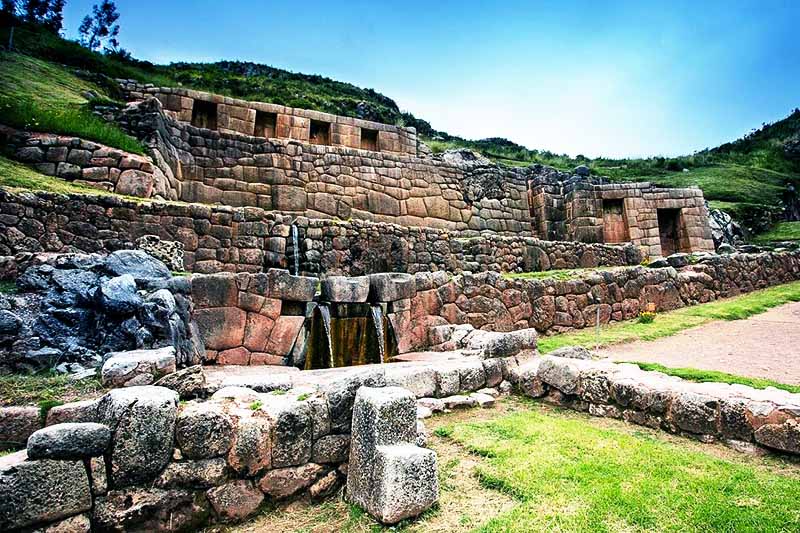
Tambomachay Archaeological Complex
Opening hours of Tambomachay
The entry to the Tambomachay archaeological site, and most archaeological sites in Cusco, is from 07:00 AM to 06:00 PM. This place remains open every day of the year, unless unforeseen emergencies occur.
What does its name mean?
- Although there is no certain definition, it is believed that Tambomachay comes from two Quechua words: ‘Tampu’ (communal lodging) and ‘Mach’ay’ (place of rest).
- This definition would explain part of its function as the ‘Inca Baths’ and water adoratory. However, other studies suggest that ‘Machay’ means ‘Caverns’.
- This also makes sense because of the rock formations that stand out in the archaeological site and the importance these formations had for the Incas.
- According to Inca cosmology, these rock formations were earthly sites that connected with the world of the dead. In any case, Tambomachay was a place of great importance during the Inca era.
| FEATURES OF THE TAMBOMACHAY ARCHAEOLOGICAL SITE | |
|---|---|
| Aspect | Description |
| Location | 9 kilometers from the city of Cusco. |
| Altitude | Approximately 3,700 meters above sea level. |
| Main function | Ceremonial center dedicated to the worship of water. |
| Distinctive elements | Advanced hydraulic system with channels and aqueducts made of stone that are still functional today. |
| Sacred significance | Associated with water as a sacred and purifying element. |
| State of preservation | Well preserved, with a constant flow of water to this day. |
| Access | Included in the Cusco Tourist Ticket (Circuit 1). |
| Opening hours | 07:00 AM to 06:00 PM. |
Functions of the Tambomachay archaeological site
Inca hunting place
- The Tambomachay archaeological site is located 3,700 meters above sea level (m.s.n.m.).
- Due to its high location, on the slopes of a mountain and over the river of the same name, it is presumed that there was once abundant Andean fauna in the area.
- For this reason, some chroniclers claim that the site was the hunting grounds of Inca Tupac Yupanqui. Among the wild animals that inhabited the Andes are the vicuña and the guanaco.
The Inca baths
- Tambomachay is one of the best examples of Inca engineering in the construction of water channels and its manipulation.
- The site features stone-carved water channels that end in two springs, which have been flowing with crystal-clear water to this day.
- At the upper part of Tambomachay, there is a sacred platform (ushnu), which likely served as a place for offerings and rituals.
- The hydraulic structures of the site allowed water to be channeled with admirable precision, suggesting that it was not just any place, which is why it was called ‘The Inca baths’ or the ‘Baths of the Ñusta’ (also in reference to being a resting place).
Water Adoratory
- Just like Tambomachay, the Incas dedicated special interest in their constructions involving water in other important sites like the fortress of Ollantaytambo, the Inca citadel of Machu Picchu; but above all, the temple of Tipón, which is considered a masterpiece of Inca hydraulic engineering.
- According to Andean cosmology, water was the source of life. It was believed that it symbolized the masculine element and the earth (pachamama) the feminine, and the union of both caused fertility.
- The network of channels that filtered water at Tambomachay would pour the liquid into a sacred platform, where the Inca worshipped water.
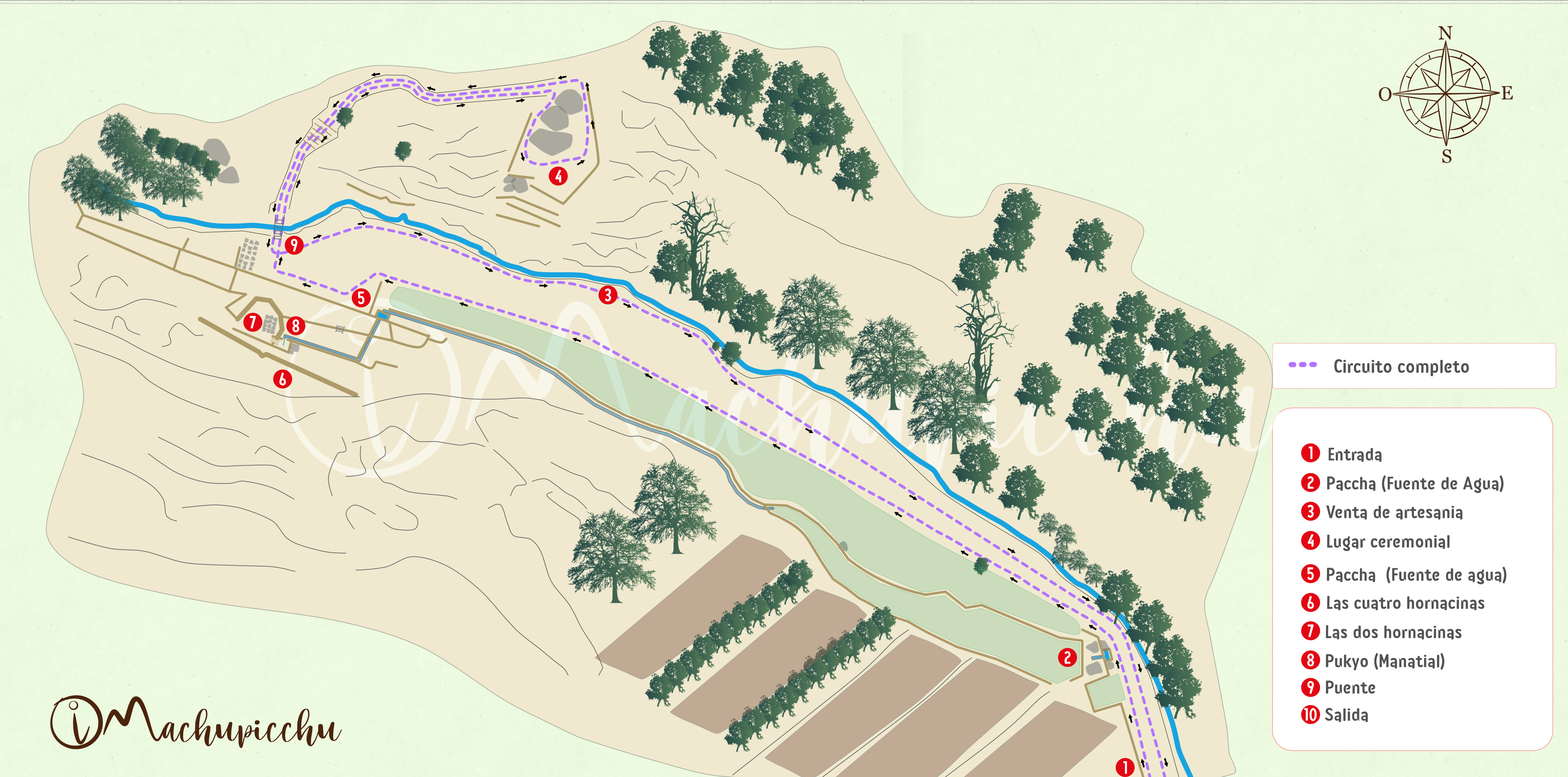
Tambomachay Archaeological Site Map
Where does the water come from?
- The Tambomachay archaeological site and water adoratory was built over a river, springs, and streams.
- Although the exact origin of the water flowing through its channels is not precisely known, the extraordinary engineering of its distribution continues to amaze the world.
- The channels descend in a stepped and perfectly proportioned system, forming small waterfalls that optimize the flow and prevent any waste of the resource.
- It is believed that the Incas calculated the flow rate of the water in the channels to prevent them from colliding. Whether this was true or not, these channels continue to flow with water after 600 years.
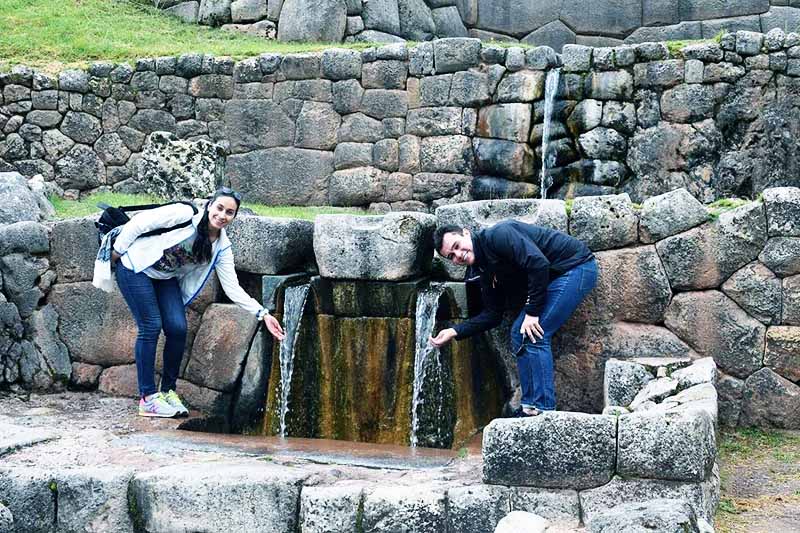
Inca Baths
Map to reach Tambomachay
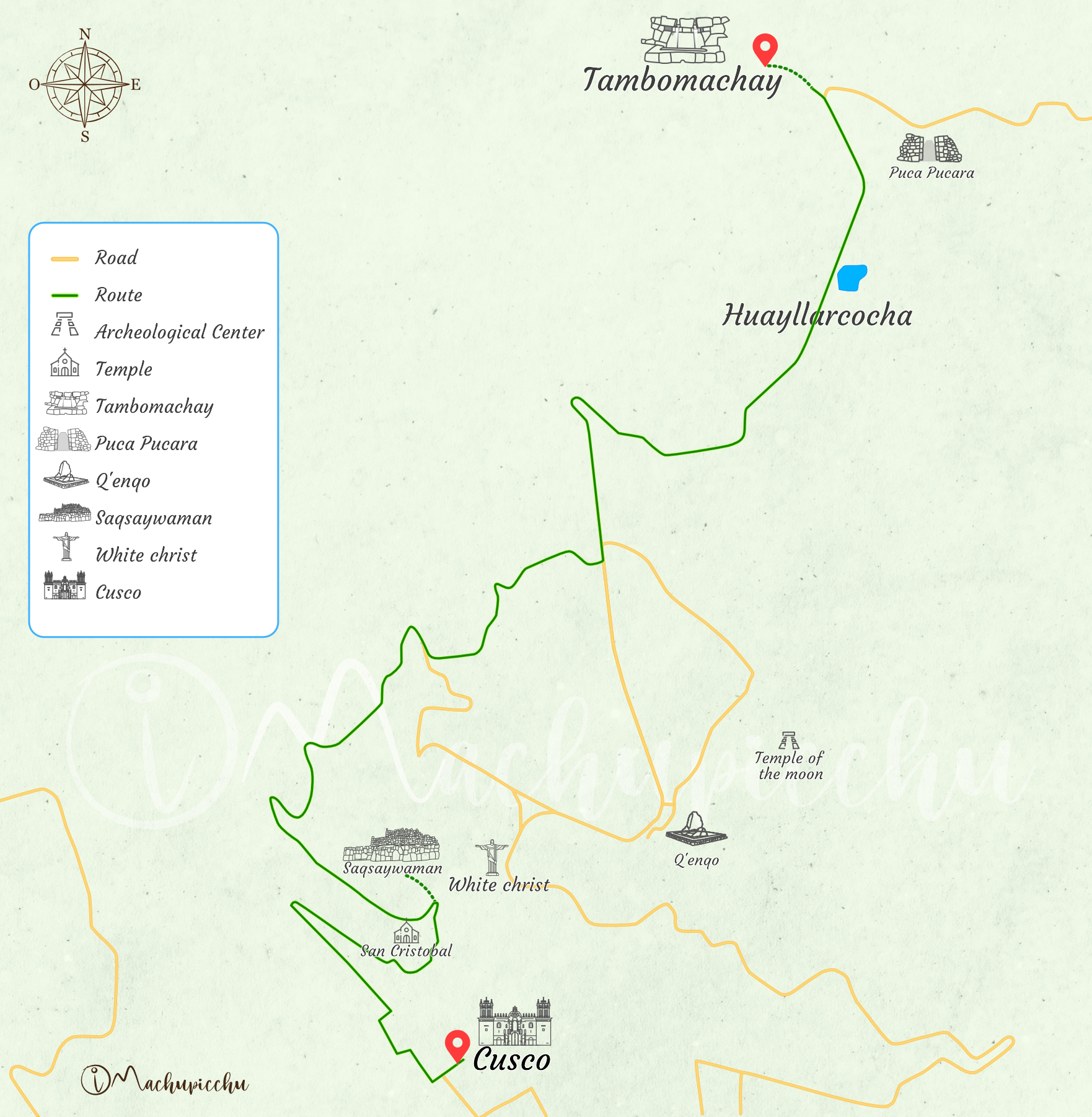
Map to reach Tambomachay from Cusco
Harmony with the surroundings
- The Tambomachay archaeological site is located under the shelter of a mountain range, over rivers and underground springs.
- The nature surrounding Tambomachay is characterized by the abundance of ichu, a natural grass that grows in high-altitude areas. During the rainy season (November to March), cantu, a multicolored flower, grows.
- The construction of the site was in harmony with its environment. The sound of the water flowing through the stone walls creates an ideal resting atmosphere.
- It is no coincidence that the Inca chose this place as his resting center. Some tour guides refer to it as the ‘Inca spa’.
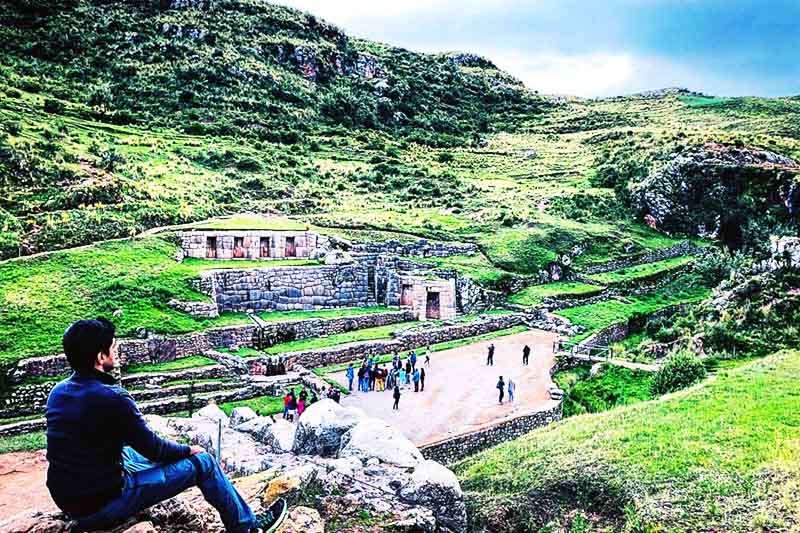
Natural surroundings of Tambomachay
Perfection in stone handling
- The hydraulic systems of Tambomachay were finely carved for the perfect flow of water.
- In addition, the site has four walls arranged in terrace form in the main complex. The stones here were irregularly shaped and assembled, but with such perfection that they remain standing after almost 600 years.
- The main wall is located at the top. This construction consists of 4 trapezoidal niches up to 2 meters. Due to the height of these walls, it is presumed that they also served as defense against possible enemy attacks.
- These stone-handling techniques are also observed in the archaeological sites of Qenqo, Puca Pucara, and Sacsayhuaman, all included in the City Tour Cusco.
Entrances to Tambomachay
- To enter the Tambomachay archaeological site, you need to purchase the Cusco Tourist Ticket, either in its full option (16 tourist destinations included) or in Circuit 1 (which includes Tambomachay, Sacsayhuamán, Qenqo, and Puca Pucara).
| ENTRANCE TO TAMBOMACHAY ARCHAEOLOGICAL SITE | ||||
|---|---|---|---|---|
| Option | Tour sector | Included attractions | Price | Validity |
| Full Ticket | Main archaeological and historical sites of Cusco | Sacsayhuamán, Qenqo, Puca Pucara, Tambomachay, Ollantaytambo, Pisac, Chinchero, Moray, Tipón, Piquillacta, Qosqo Native Art Center, Qoricancha site museum, Regional History Museum, Contemporary Art Museum, Pachacútec monument, and Popular Art Museum | 130 soles for foreigners 70 soles for locals | 10 days |
| Circuit 1 | Cusco City | Sacsayhuamán, Qenqo, Puca Pucara, and Tambomachay | 70 soles for foreigners 40 soles for locals | 1 day |
Frequently Asked Questions
1) What is the Tambomachay archaeological site like?
Tambomachay is one of the most important archaeological complexes in Cusco, alongside Sacsayhuamán, Qenqo, and Puca Pucara. Its visit is highly recommended due to its advanced hydraulic system and its ceremonial significance related to the worship of water.
2) Where is Tambomachay located?
Tambomachay is located approximately 9 kilometers from the city of Cusco, at about 3,700 meters above sea level. It is part of the traditional City Tour around the city.
3) What does the name Tambomachay mean?
Although there is no exact definition, it is believed to come from the Quechua words “tampu” (lodging) and “mach’ay” (resting place). This interpretation reinforces its possible function as a ceremonial and resting space for the Inca elite.
4) What was the main function of Tambomachay?
It is considered to have been a ceremonial center dedicated to the worship of water. Its hydraulic structures suggest that it played a sacred role in Andean cosmology, where water represented life and purification.
5) Where does the water that flows through its fountains come from?
The complex was built over natural springs and streams. Although the exact origin of the water is not known, the hydraulic system continues to work after more than 600 years, demonstrating the mastery of Inca engineering.
6) How is Tambomachay integrated with the natural surroundings?
The site was built respecting and blending with the natural environment and water resources of the area. It is surrounded by mountains and typical Andean vegetation, creating a peaceful atmosphere that enhances the visitor’s experience.
7) Can Tambomachay be visited on an organized tour?
Yes, the visit to the Tambomachay archaeological site is included in the Cusco City Tour, which also visits the Cathedral, the Qoricancha temple, and the sites of Sacsayhuamán, Qenqo, and Puca Pucara.
8) What type of ticket do I need to enter?
To access Tambomachay, it is necessary to purchase the Cusco Tourist Ticket, either in its full option or in Circuit 1, which includes the main archaeological sites near the city.
9) What are the visiting hours for Tambomachay?
Entry to Tambomachay is available every day of the year from 7:00 AM to 6:00 PM, like most archaeological sites in Cusco.
10) How long does it take to visit all of Tambomachay?
The tour of Tambomachay takes approximately 45 minutes to an hour. This time allows you to explore the archaeological complex, appreciate its water fountains, and understand its historical significance.
Advice from people who have been there
 By: Andrei F.
“Amazing engineering!“
“It is a wonderful archaeological complex where you can easily see the engineering the Incas had to transport natural water, engineering that has remained intact for over a hundred years.“
By Ticket Machu Picchu – Last updated, March 4, 2026