Qenqo Archaeological Site
The Quechua name Qenqo means ‘labyrinth’. In the worldview of the Andean culture, this place was built to invoke the ‘kaypacha’, a legendary serpent that gave birth to life. The importance of this place also lies in its underground tunnels, as the Incas believed that caves connected the earthly world with the world of the dead. Today, it is one of the most visited archaeological sites in the city of Cusco.
- Qenqo Archaeological Site
- Location
- Qenqo Map
- Large Qenqo
- Small Qenqo
- Qenqo Tours
- Self-guided Trip
- Qenqo Photos
- Frequently Asked Questions about Qenqo
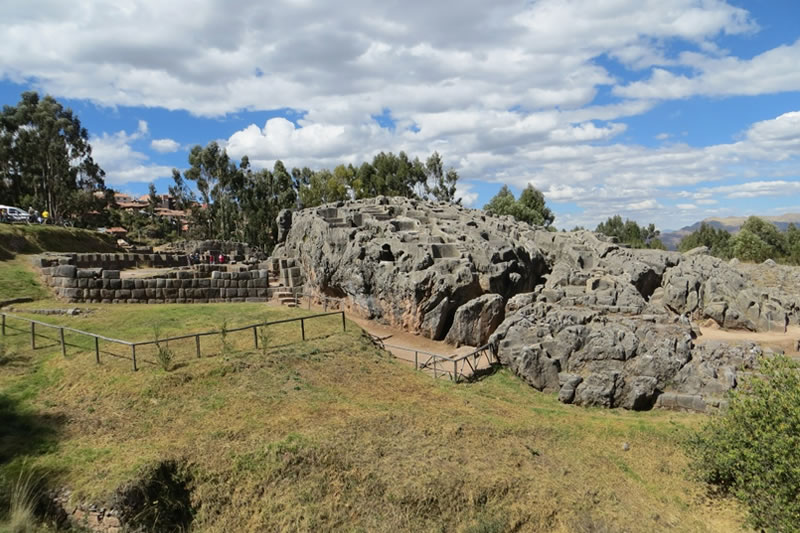
Qenqo Archaeological Site, 4 km from Cusco’s Main Plaza
Opening Hours for Qenqo Archaeological Site
The Qenqo archaeological site is open every day of the year, from 7:00 AM to 6:00 PM. This schedule is the same as most archaeological sites in the city, ideal for combining multiple destinations in one trip.
Qenqo Archaeological Site
- The Qenqo archaeological site was an Inca religious site where religious ceremonies took place. It mainly features tunnel-like structures beneath the earth, commonly referred to as Chincanas.
- There is also a small square in the shape of an amphitheater, where ceremonies of various kinds were likely held. One of its most famous buildings is the mysterious ‘sacrificial hall’, where mortuary rituals probably took place.
- Although the true name of this temple is unknown, it was named during the colonial era. Its name, translated from Quechua, means ‘labyrinth’. It may refer to the labyrinthine galleries underground or the zigzagging channels carved in the rock observed there.
- This place is classified as an amphitheater due to its semicircular construction. However, its true function is unknown. It could have been a ceremonial center, a court, or a tomb. According to research, it would have been one of the most important religious sites in Cusco.
| FEATURES OF THE QENQO ARCHAEOLOGICAL SITE | |
|---|---|
| Aspect | Main Features |
| Location | 4 kilometers northeast of Cusco. Part of the Sacsayhuamán Archaeological Park. |
| Height | Approximately 3,580 meters above sea level. |
| Period | Inca Culture, around the 15th century. |
| Name Meaning | Qenqo in Quechua means “labyrinth” or “zigzag”, referring to its carved channels. |
| Function | Ceremonial and religious center. Associated with rituals linked to the worship of the earth, water, and possibly funerary practices. |
| Notable Features | Ceremonial channels, carved altar, semicircular exterior amphitheater. |
| Access | Included in the Cusco Tourist Ticket (Circuit 1). |
| Opening Hours | From 7:00 AM to 6:00 PM. |
Location
- The Qenqo archaeological site is located 4 kilometers from Cusco’s Plaza de Armas, on Socorro Hill. It stands at 3,580 meters above sea level (asl).
- To get there, you can take a taxi (15 minutes) or use public transportation (Señor del Huerto company), which will drop you off near the entrance.
- The best way to reach Qenqo is to book an organized tour. This experience not only includes tourist transportation but also a professional guide and tickets to the tourist sites of Qenqo, Sacsayhuamán, Puca Pucara, Tambomachay, the Cathedral, and the Qoricancha temple.
Map to Reach Qenqo
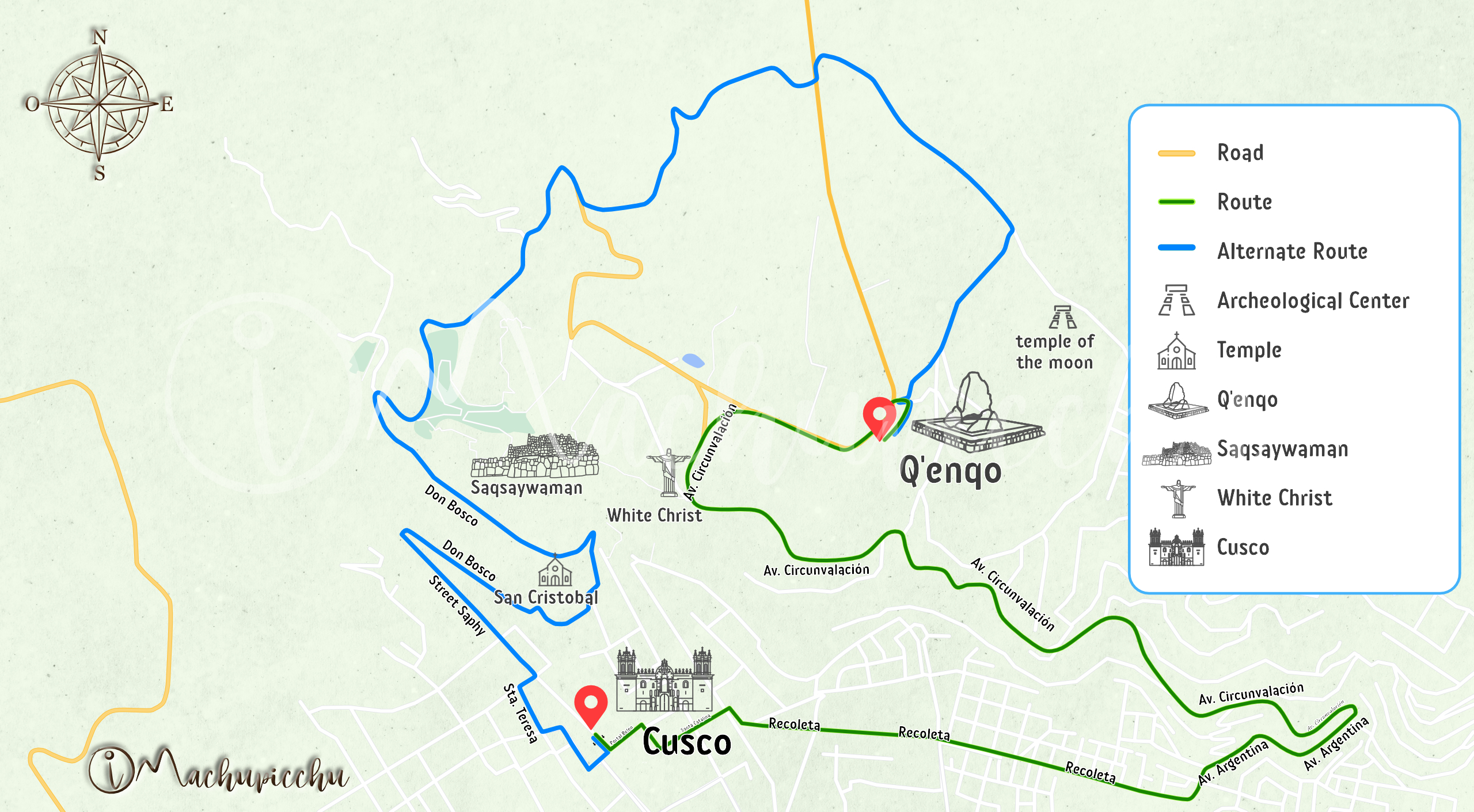
Map to Reach Qenqo
Large Qenqo
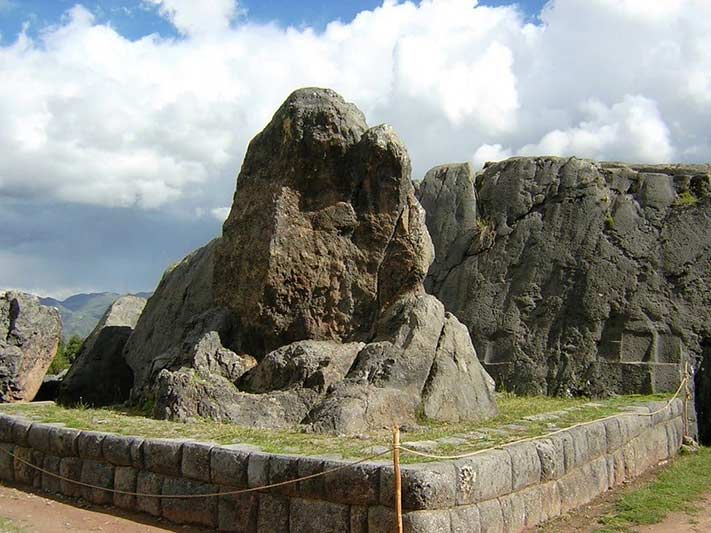
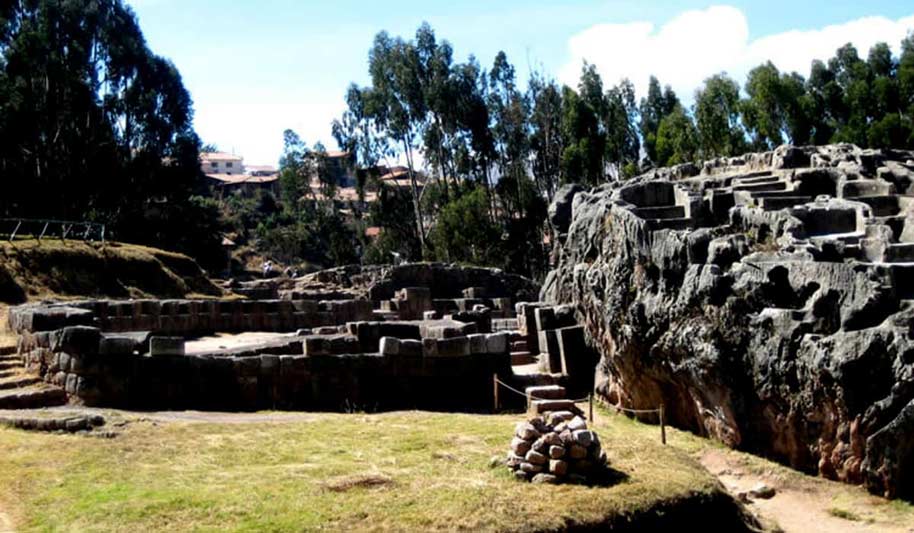
- The Amphitheater – This is a temple used during the Inca period for public ceremonies. It is circular in shape with a diameter of 55 meters. Notable are the 19 unfinished niches around the walls. At the top, a large 6-meter-high stone block rests on a rectangular pedestal. The amphitheater has a carved passage leading to an underground room, chambers, a set of terraces, and a drainage system to evacuate water.
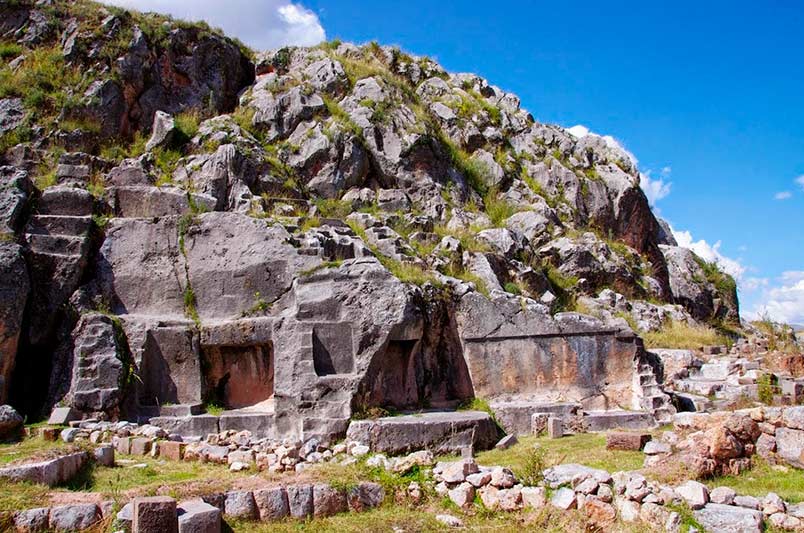
- The Huaca – A massive rock formation with peculiar carvings, featuring lateral stairs leading to the summit. At the top, there is a small hole connected to a zigzagging channel that splits into two: one follows the slope, and the other descends to an underground chamber.
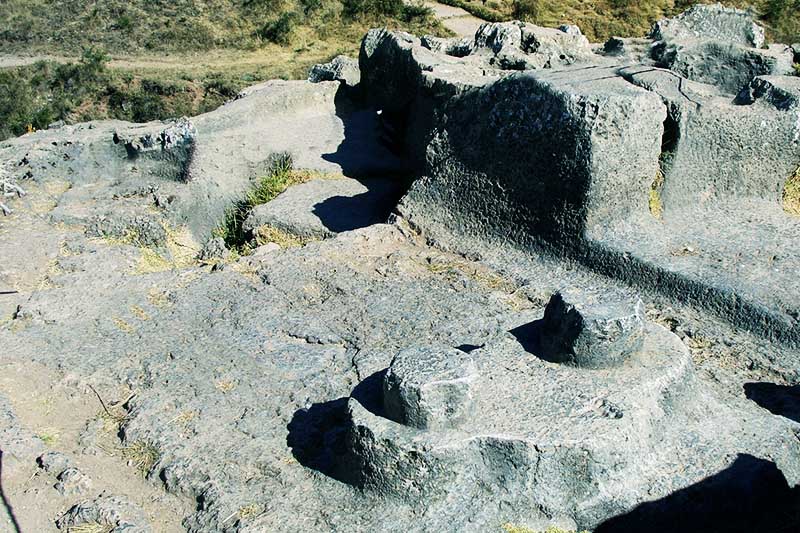
- Intihuatana and Astronomical Observatory – A polished rock featuring two small cylinders carved with great precision. Investigations suggest it is an ‘Intihuatana’ (place where the sun is tied), a monolith used to calculate the sun’s position and determine the correct timing for agricultural work. It marked solstices and equinoxes.
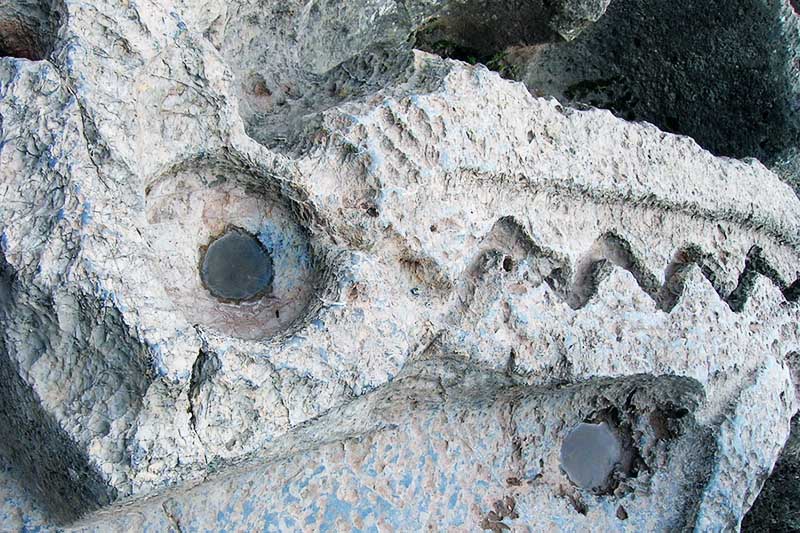
- Cusilluchayoc – A mysterious area with zoomorphic rock formations. Notable is a carved stone almost 2 meters tall, resembling a frog. There are also carvings of monkeys and serpents. Cusilluchayoc is a Quechua word meaning ‘temple or place with monkeys’.
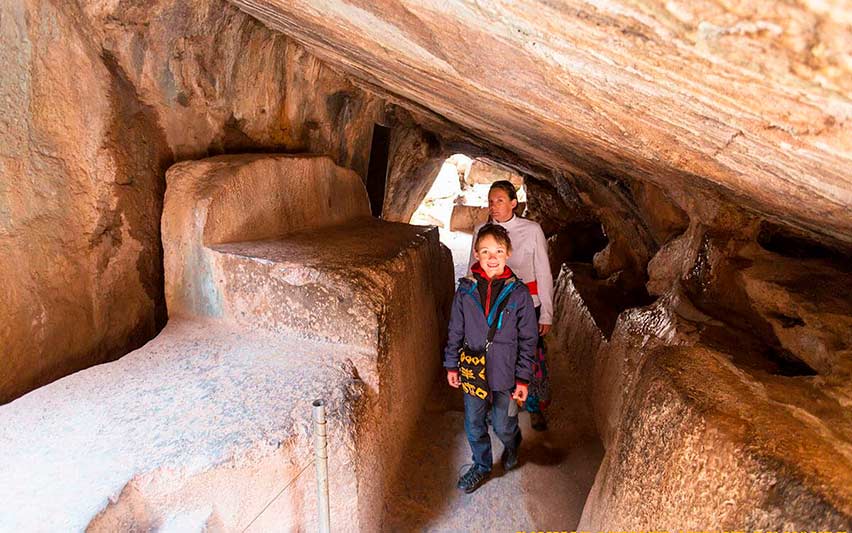
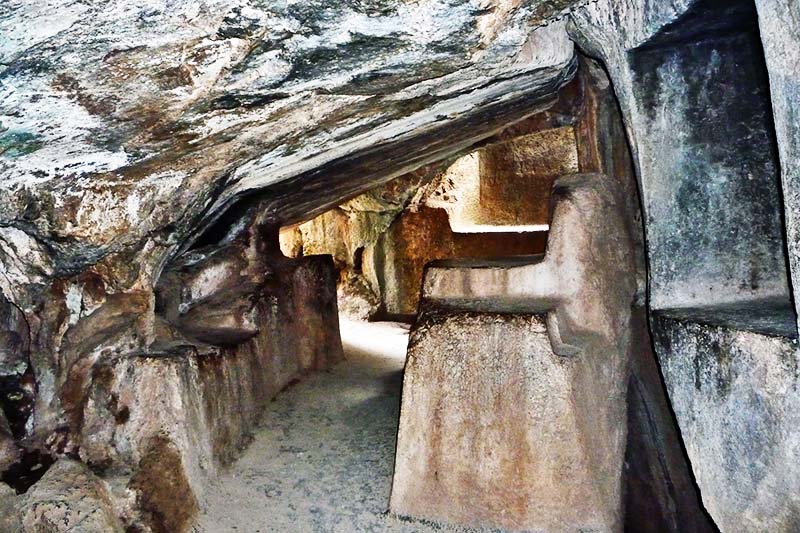
- The Underground Chamber – A stone structure carved with great effort beneath the earth, forming various shapes like floors, tables, niches, and walls. Religious rituals were held here. It also has service rooms nearby and a drainage system for rainwater. The liquid, possibly llama blood, was poured from the carved stone as part of religious ceremonies.
- The Sacrifice Room – Inside the underground chamber, there is a ceremonial table where the embalming of the dead or animal sacrifices may have taken place for religious purposes. It is one of the most mysterious and popular structures in Qenqo.
Small Qenqo
- Small Qenqo refers to a set of semi-destroyed buildings and terraces located on the slopes of Socorro Hill. You can distinguish the remains of high walls, a circular urban layout, and several rock formations with vague figures.
- This place is free to visit compared to Large Qenqo. On the tour, you can also glimpse the area of the queuña forests, ideal for spending the afternoon and engaging in outdoor activities surrounded by nature and panoramic views of the city.
Qenqo Tours
- The Qenqo archaeological site is part of the famous ‘City Tour Cusco’ half-day tour. This service can be booked for the afternoon or morning, with a cost of approximately 60 USD per tourist.
- The experience includes visits to the Cathedral, Qoricancha, and the archaeological sites of Qenqo, Puca Pucara, Tambomachay, and Sacsayhuamán. It also includes full transportation, entrance tickets, and a professional tour guide service.
- The tour is easy to book and can be available with just a few days’ notice. You can book it online through a travel agency or in the city itself.
Self-Guided Trip
- To visit Qenqo on your own, you must purchase the ‘Cusco Tourist Ticket’. You can choose between the Integral option (16 destinations included) or Circuit 1 (which includes Qenqo, Puca Pucara, Tambomachay, and Sacsayhuamán).
- Next, you will need to choose your mode of transportation. The easiest option is to take a taxi. However, there are public buses that cover the entire classic route (Sacsayhuamán 🡢 Qenqo 🡢 Puca Pucara 🡢 Tambomachay).
| CUSCO TOURIST TICKET | |||
|---|---|---|---|
| Option | Included Attractions | Fee | Validity |
| Integral Ticket | All destinations from the three circuits |
| 10 days |
| Circuit 1 | Sacsayhuamán, Qenqo, Puca Pucara, and Tambomachay |
| 1 day |
| Circuit 2 | Tipón, Piquillacta, Qosqo Center of Native Art, Qoricancha Site Museum, Regional Historical Museum, Contemporary Art Museum, Pachacútec Monument, and Popular Art Museum |
| 2 days |
| Circuit 3 | Ollantaytambo, Pisac, Chinchero, and Moray |
| 2 days |
Qenqo Photos
Frequently Asked Questions about Qenqo
1. How to get there on my own?
To get there on your own, you can take public transport at the ‘Rosaspata’ stop. The cost of the trip is only 1 Peruvian sol per person. You can also walk from the Plaza de Armas. The most expensive option is by taxi.
2. What other archaeological sites in Cusco should I visit?
The city of Cusco houses several important Inca archaeological sites. In addition to Qenqo, tourists can visit: Sacsayhuamán, Coricancha, Pucapucara, and Tambomachay.
3. What should I bring during the visit?
During your visit to Qenqo, don’t forget to bring a rain poncho (since it can rain at any moment), as well as a hat, sunscreen, comfortable clothing, and good shoes. Of course, don’t forget to bring some snacks, rehydrating water, extra cash, and your ID documents.
4. Is it very cold at Qenqo?
Qenqo is at a high altitude, where the cold and wind can be bothersome. However, the archaeological site is open from 8 AM to 5 PM, when the temperature is mild with sunshine. The average temperature is around 13°C.
5. Can I suffer from altitude sickness?
Not only at Qenqo, but throughout Cusco, tourists may experience some symptoms of altitude sickness, such as nausea, fatigue, and shortness of breath with physical exertion. To reduce these symptoms, it is recommended to drink plenty of water and avoid fatty foods. Altitude sickness usually disappears after 1 or 2 days of acclimatization.
7. How can I visit Qenqo cheaply?
The best way to visit Qenqo cheaply is to buy the ‘Cusco Tourist Ticket’ and use public transportation to get there and visit all the nearby tourist attractions included in the ticket.
8. When is the best time to go?
The dry season (from April to October) is the best time to visit Qenqo and the city of Cusco. During these months, rain is unlikely, making the visit more enjoyable. Keep in mind that the rainy season is from November to March.
8. Is it necessary to purchase the full Cusco Tourist Ticket?
Not necessarily, you can also purchase the Circuit 1 Cusco Tourist Ticket, which is a more affordable option and also allows you to visit Sacsayhuamán, Pucapucara, and Tambomachay.
9. How much time should I spend exploring Qenqo?
The Qenqo archaeological site can be explored in about one hour, which is enough time to see each of its emblematic constructions. If you want to extend your experience, you can also visit Small Qenqo and the queuña forest area.
10. What is the City Tour Cusco experience like?
The Cusco City Tour includes entry to the main tourist destinations in the city, as well as transportation and a tour guide service. It is a half-day experience (5 hours) that can be booked in the morning (8:30 AM) or in the afternoon (12:30 PM).
Advice from people who have been there
 By: Dominic C.
“City Tour Experience“
“I felt very comfortable experiencing the City Tour. The tourist spots were closer than I expected. The nature and archaeological sites combine into very beautiful landscapes. An unmissable travel experience.“
By Ticket Machu Picchu – Last updated, March 5, 2026